Showing posts with label talents. Show all posts

Friday, September 24, 2021

"Leading Talents, Leading Teams"

"Leading Talents, Leading Teams" - Aligning People, Passions, and Positions for Maximum Performance by Lee Ellis 

 I want to focus on a book by Lee Ellis (a friend, colleague, and mentor) called "Leading Talents, Leading Teams." Specifically, I want to focus on Section 1 titled, "Individual Differences." 

This section introduces talents, and explains their importance and why we have so much difficulty in being objective about ourselves and others...whether on the job or outside the workplace. Lee has taught me that we really can learn how to better understand ourselves and others to optimize our performances on the job or in our personal lives. 

 According to Lee, talents focus teams on maximum performance and are the keys to organizational and personal success. However, too many times we mismatch the talents of a person on our team and that causes problems for everyone. Over the years, I have had experiences where the person I thought had the talent for a particular job failed at that job miserably. I wish I had known then what I know now about talents and matching personalities/behaviors with those talents. I would have saved myself and the team member a lot of time and misery by refocusing not only on the talent but ensuring that the person I was putting into that job had the right personality and behavior for the job as well. 

That is what Lee means when he says "Aligning People, Passions, and Positions for Maximum Performance." Think about it, if you have ever had to hire someone...wasn't that experience like a guessing game? You do the interviews and check the references, but you never really know if that person will be a match for your position or team based on the behavior after you hire them. 

So, "Leading Talents, Leading Teams" is all about understanding the 16 personality types that all of us can be tested for. By understanding that personality type and the talents of each of us and those we work with, we can really say that we are aligned for maximum performance. 

You can find Lee's Leading Talents, Leading Teams book on Amazon at:  https://www.amazon.com/Leading-Talents-Teams-Positions-Performance/dp/1881273296


So, wouldn't it be nice to find out what kind of personality you are? By using Lee's book you can do just that.  After that, the next time you are looking at hiring someone, you will have an opportunity to test them as well and find out if you are both a match for each other and/or your team. What a wonderful tool! 

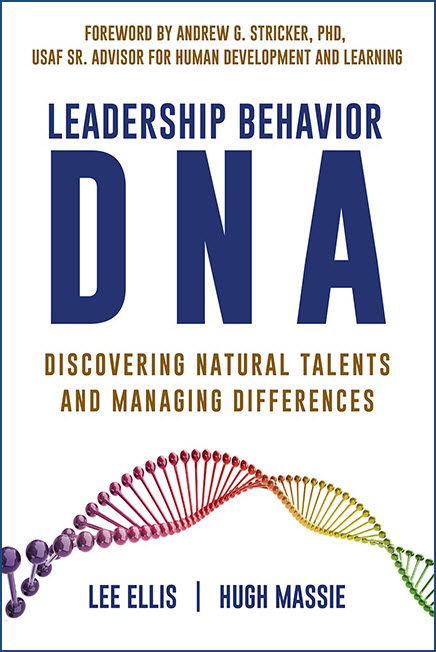
Lee also has another book titled "Leadership Behavior DNA:  Discovering Natural Talents and Managing Differences."


To learn more, visit Lee at https://www.leadingwithhonor.com/products/leadership-behavior-dna/ Keep growing and leading yourself and your teams with Character First! Trike On! Coach Dane

Saturday, October 31, 2009

"Blind Spots in Our Lives"

"Blind Spots"


Next week, I will be in Orlando, Florida teaming with one of my mentors, friend and colleague, Lee Ellis.  We will be co-presenting a seminar titled, "Character in Motion: Character is evidenced by Leadership Behavior."

Lee also wrote a book called "Leading Talents, Leading Teams."  Because he and I are teaming on this seminar, I thought it would be fun to blog on a piece of work Lee did by sharing a part of what he wrote in Chapter 3 of his book is titled, ” Objectivity: Seeing Reality”.

Of course, each of us is very objective about our own lives right? Everyone else has a problem with their character or behavior, correct? Lee says, “Objective: Of course we are. NOT!” To be a strong leader of character, what is really vital to our success is that we be objective and have an accurate view of ourselves. Lee reminds us that without objectivity we are missing an extremely important factor in our ability to process decision-making information accurately. Without objectivity, Lee argues, we may lack credibility. And without credibility of course, no leader can gain the trust of their followers or those they influence.

So, how do we determine how we should see ourselves? One of the first steps is to realize that as Lee puts it, “Our self-view distorts the lens through which we view others.” Lee points out that our brains are rarely accurate in developing opinions and decisions of others. The reasons for that are many, but primarily it is because of what Lee calls “filters” that we are limited in our objectiveness. Our experiences for instance, form a type of filter that removes a piece of reality from what we are processing. Once a filter is in place, we are prone to bad judgments that can result in bad decisions.

So, if we are not objective about ourselves,” our self-view also distorts the lens through which we view others.” That distorted view is what Lee calls “blind spots.” Some people are so blind to some of their struggles (weaknesses) that they even deny their existence. Do you know what your strengths and struggles are? Furthermore, are you aware of blind spots in your life? Regardless, whether we acknowledge them or not, we all do have blind spots.

To answer those questions, we have to be brutally honest with ourselves and realize that we need to be objective in seeing reality in our own lives. If we acknowledge that we all have some type of “blind spot” in our lives that distorts and/or filters how we interpret others, that may be the best step toward becoming a more whole person who can be a stronger leader, and whose character can influence others to trust them. Lee also says that a lack of objectivity can cause unrealistic expectations, because when we expect someone to respond or behave in one way and they don’t, that expectation can lead to disappointment, hurt feelings, and anger.

To sum up the chapter, Lee says that, “Awareness is the way, and courage is the entrance fee to gain an objective viewpoint.” Are you willing to learn what your blind spots are?  I encourage you to take an objective look at who you really are so that you can objectively view others around you. By doing that you will have made great progress in your development as a leader and your growth as a person of character.

Until next time, keep "Leading with Character First!"  Heidi Ho - Dane